Mangrove Forests of Los Haitises: Wildlife & Nature Guide

Mangrove Forests of Los Haitises National Park: Wildlife, Coastal Habitats and Nature Experiences
The mangrove forests of Los Haitises National Park are among the most recognizable features of this protected natural area in the Dominican Republic. Their dense green vegetation, unusual root systems and winding waterways create a landscape that visitors can experience by boat or, on selected guided excursions, by kayak.
These forests are more than beautiful scenery. Mangroves provide important habitats for birds, fish, crabs and other coastal wildlife. Their roots help hold coastal sediments in place, while their branches offer shelter and resting places for different species.
Los Haitises is particularly interesting because its mangroves form part of a wider natural landscape that includes tropical forests, limestone formations, wetlands, coastal islands and sheltered waterways.
This guide explores the mangrove forests, the different types of mangrove trees, the wildlife associated with them and what visitors can expect when discovering this natural environment.
1. Where Are the Mangrove Forests of Los Haitises?
Los Haitises National Park is located in the northeastern Dominican Republic, around the coastal landscape of San Lorenzo Bay and the wider Samaná region.
Mangroves grow in several coastal and estuarine areas within the park. They are particularly associated with sheltered waterways, river mouths and coastal sections where land and seawater meet.
The park's mangrove scenery is especially noticeable from the water. Visitors may see dense vegetation along the shoreline, exposed roots extending into shallow water and narrow channels bordered by trees.
The park management documentation identifies mangroves in areas including:
- The mouth of the Barracote River
- San Lorenzo Bay
- The Caño Hondo River
- Boca del Infierno
These locations help illustrate the distribution of mangrove habitats within the park. They should not be interpreted as a list of places that every visitor tour will enter.
2. What Makes Los Haitises Mangroves Special?
Mangroves are coastal trees and shrubs adapted to environments influenced by saltwater, freshwater and changing water levels.
Unlike many ordinary forest trees, mangroves can grow in waterlogged coastal soils. Their roots and other adaptations help them survive conditions that are difficult for many other plants.
In Los Haitises, the mangrove landscape creates a transition between the land and the sea. The forests connect coastal vegetation with waterways, sheltered bays and surrounding habitats.
Visitors may notice:
- Roots extending above or into the water
- Dense branches forming green corridors
- Shallow water around the trees
- Reflections of vegetation on calm waterways
- Birds resting or feeding near the shoreline
- Different patterns of vegetation along the coast
The appearance of a mangrove forest can change from one location to another. Water depth, salinity, sediment and local growing conditions influence the vegetation.
3. Four Characteristic Mangrove Types
Four characteristic mangrove species are associated with Caribbean coastal mangrove communities and are documented in the Los Haitises management literature.
Each has recognizable features that make it interesting to observe.
Red Mangrove
<em>Rhizophora mangle</em>
Red mangrove is especially recognizable because of its arching supporting roots, often called prop roots.
These roots extend from the trunk and branches toward the ground or water, creating a distinctive network around the tree.
In suitable areas, red mangroves can form dense stands along the water's edge. Their root systems provide surfaces and sheltered spaces used by aquatic organisms.
When looking at red mangroves, notice how the roots connect the tree with the surrounding water and sediment.
Black Mangrove
<em>Avicennia germinans</em>
Black mangrove has a different root structure. It can develop upright aerial roots, known as pneumatophores, which emerge from the soil around the tree.
These roots are one of the most interesting features to observe in suitable habitats.
Black mangroves are adapted to coastal conditions where soils may remain waterlogged and oxygen availability below the surface can be limited.
White Mangrove
<em>Laguncularia racemosa</em>
White mangrove is another characteristic species of Caribbean coastal environments.
It generally has a different appearance from red mangrove and may grow in areas with varying degrees of tidal influence and soil moisture.
Its leaves and overall tree structure can help visitors distinguish it from other mangroves, although accurate identification is best done with a knowledgeable guide.
Buttonwood
<em>Conocarpus erectus</em>
Buttonwood is a coastal tree commonly associated with mangrove communities.
It is often included in descriptions of the four characteristic Caribbean mangrove types, although it is sometimes classified more precisely as a mangrove associate rather than a true mangrove.
It may grow toward the landward edge of coastal vegetation, where conditions differ from the wetter areas occupied by other mangrove species.
Why are these differences interesting?
Looking at the different roots, leaves and growing locations helps visitors understand that a mangrove forest is not made up of one identical type of tree.
Each species has adaptations that allow it to occupy particular parts of the coastal environment.
Do not remove leaves, seeds or branches to identify a plant. Observe from the authorized route and ask your guide for explanations.
4. Wildlife That Uses Mangrove Habitats
Mangrove forests support a variety of wildlife because they provide shelter, feeding opportunities and connections between coastal habitats.
The exact animals present vary between locations and seasons. Visitors should not expect to see every species during a single excursion.
Birds
Birds are among the most noticeable animals associated with mangrove environments.
Depending on the location, visitors may observe:
- Brown pelicans
- Herons
- Egrets
- Frigatebirds
- Other coastal and wetland birds
Some birds rest in branches, while others search for fish and other food in shallow water.
The park's official tourism information highlights pelicans, herons and egrets among the birds associated with Los Haitises.
Fish and juvenile marine life
The water between mangrove roots can provide sheltered habitat for small fish and other aquatic organisms.
Young marine animals may use these protected areas during early stages of development, depending on the species and local conditions.
Mangroves therefore form part of a wider coastal food web connecting sheltered waterways with bays and marine environments.
Crabs and other invertebrates
Mangrove mud, roots and shallow water create small habitats for crabs, mollusks and other invertebrates.
These organisms contribute to food chains and help process organic material within the ecosystem.
Although visitors may not see them clearly from a boat, they are part of the life supported by the mangrove environment.
Other coastal wildlife
Reptiles and other animals may also use suitable mangrove and coastal habitats.
The presence of a species in the wider park does not mean it will be found in every mangrove channel. Wildlife observation depends on the location, season and natural behavior of animals.
5. How Mangroves Support the Coastal Environment
Mangroves provide several important benefits to the coastal environment of Los Haitises.
Supporting coastal wildlife
The roots, branches and surrounding water create different habitats for animals.
Birds may use trees for resting or nesting, while aquatic organisms can use sheltered spaces around the roots.
Helping stabilize coastal sediments
Mangrove roots can slow water movement and help trap sediments.
This contributes to the stability of some coastal areas and helps reduce the movement of loose sediment.
Providing nursery habitat
Mangrove waterways can provide shelter and feeding opportunities for young fish, shrimp, crabs and other aquatic organisms.
These habitats form part of the wider ecological system that supports coastal fisheries and marine biodiversity.
Reducing some coastal impacts
Mangrove forests can help reduce wave energy and provide a natural buffer along certain coastlines.
Their protective effect varies with forest width, density, water depth, storm conditions and local geography. Mangroves do not eliminate coastal flooding or storm damage, but healthy forests can contribute to coastal resilience.
Connecting coastal ecosystems
Mangroves are linked with nearby rivers, wetlands, bays and marine habitats.
The health of these environments is connected. Changes in water quality, sediment movement or coastal land use can affect the wider system.
6. What Does a Mangrove Forest Look Like From the Water?
For many visitors, the first close experience of Los Haitises mangroves happens during a guided boat excursion.
From the water, the forest may appear as a continuous green wall along the channel. As the boat moves through a permitted route, visitors can notice how roots extend into the water and how branches form shaded areas above the surface.
Some sections may feel narrow and enclosed, while other parts open toward wider waterways or the bay.
The experience provides a different perspective from looking at mangroves from land.
Visitors can observe:
- The shapes of exposed roots
- The transition between water and vegetation
- Reflections on calm water
- Birds around the forest edge
- Changes in vegetation along the route
Not every tour enters every mangrove area. Confirm the actual route and duration with the operator before booking.
7. Can You Explore the Mangroves by Kayak?
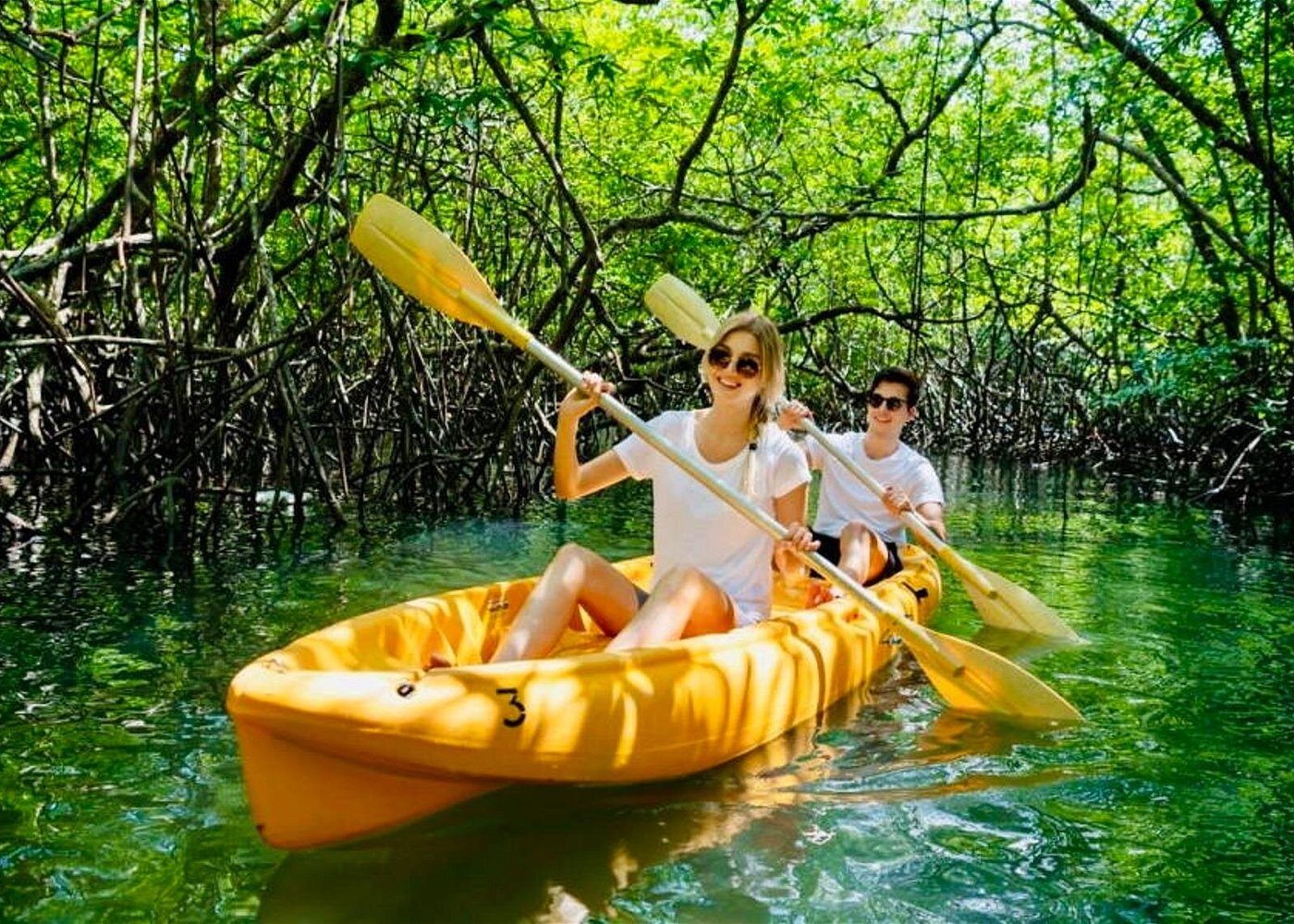
Some guided excursions in Los Haitises include kayaking through mangrove channels.
Kayaking can provide a slower way to experience suitable waterways. It may allow visitors to notice small details of the vegetation and surrounding habitats while moving at a quieter pace.
However, not every boat excursion includes kayaking, and not every waterway is necessarily open for independent paddling.
Before selecting a kayaking experience, ask:
- Which mangrove area does the route visit?
- Is the activity guided?
- Are kayaks, paddles and life jackets provided?
- How long is the paddling portion?
- Is previous experience required?
- What happens if weather or water conditions change?
Follow the guide's instructions and avoid striking or pushing against mangrove roots with your paddle.
8. Best Things to Observe During a Mangrove Visit
You do not need to be a specialist naturalist to appreciate Los Haitises mangroves.
A few simple observations can make the experience more interesting.
Look at the root systems
Compare the visible shapes of the roots. Red mangroves have recognizable supporting roots, while black mangroves may have upright aerial roots.
Notice the vegetation along the water
Observe how the forest changes between the water's edge and higher ground.
Watch for birds
Look for birds resting in branches or feeding near the shoreline. Binoculars can help you observe without approaching too closely.
Observe the water and reflections
On suitable days, the water may reflect the trees and branches, creating attractive natural scenery.
Listen to your guide
A guide can explain the importance of mangroves, identify plants and describe the wildlife that uses the habitat.
The best visit is one that allows time for observation instead of rushing through the area.
9. Photography in the Mangrove Forests
Mangroves offer many interesting subjects for nature photography.
The combination of roots, leaves, water and changing light creates opportunities for both wide landscape photographs and close-up details.
Consider photographing:
- Red mangrove prop roots
- Black mangrove aerial roots
- Green vegetation along narrow channels
- Reflections on the water
- Birds near the shoreline
- The transition between mangroves and open water
A waterproof phone case or camera bag is useful during boat and kayaking excursions.
Avoid leaning out of a boat to take photographs or asking an operator to approach wildlife too closely. Protecting the habitat is more important than getting a particular picture.
10. Best Conditions for Enjoying a Mangrove Visit
There is no single weather condition that guarantees the best mangrove experience.
The appearance of the forest and the comfort of the excursion can depend on rainfall, water levels, wind and the operator's route.
Before departure, ask about:
- Expected weather conditions
- Whether the route is suitable for the planned activity
- The expected time on the water
- Whether the excursion may be changed due to conditions
- Any clothing or footwear recommendations
If birdwatching is important to you, ask whether the schedule allows time for quiet observation.
Always follow the operator's advice if conditions make a particular route unsuitable.
11. Responsible Tourism in the Mangrove Forests
Mangroves are sensitive natural habitats. Visitors should enjoy them without damaging vegetation or disturbing wildlife.
Follow these simple rules:
- Never break or remove mangrove branches.
- Do not pull on exposed roots.
- Never throw rubbish into the water.
- Do not feed birds or other wildlife.
- Keep noise low near resting or nesting animals.
- Stay on authorized boat and kayak routes.
- Do not enter restricted areas.
- Follow your guide's instructions.
- Do not remove shells, plants, rocks or other natural objects.
The Dominican Republic's environmental visitor guidance emphasizes protecting natural resources, avoiding litter and not disturbing wildlife.
Responsible behavior helps preserve the mangrove forests for future visitors and the animals that depend on them.
12. How to Choose a Mangrove Nature Tour
If your main interest is seeing the mangrove forests, compare tour itineraries carefully.
Route: Ask whether the excursion includes a dedicated mangrove section.
Activity: Confirm whether the experience is by motorboat, kayak or a combination.
Duration: Find out how much time is spent among the mangroves rather than traveling between different attractions.
Guide: Ask whether the guide explains the mangrove ecosystem and can identify common trees and wildlife.
Group size: Check the number of passengers or participants.
Safety: Confirm the availability of appropriate safety equipment for the selected activity.
Facilities: Ask whether drinking water, food, restrooms and changing facilities are available at the departure point or during the excursion.
Access: Confirm that the planned route is currently authorized.
A tour description should clearly explain what is included. Do not assume that every package provides the same route, meals, equipment or visitor facilities.
13. Why Protecting Los Haitises Mangroves Matters
Mangrove forests are important natural habitats, but they can be affected by coastal development, pollution, changes in water movement and other human pressures.
Protecting these forests is not only about preserving attractive scenery. It is also about maintaining habitats for wildlife and supporting the wider coastal environment.
Visitors can contribute by choosing responsible tour operators, following park rules, taking rubbish away and avoiding activities that damage vegetation.
Respectful tourism also helps people understand why protected natural areas matter.
When visitors learn about mangrove roots, coastal wildlife and the relationship between land and sea, the excursion becomes more than a sightseeing activity. It becomes an opportunity to appreciate the natural systems that make Los Haitises special.
Frequently Asked Questions
1. Does Los Haitises National Park have mangrove forests?
Yes. Mangroves are a major feature of the park's coastal landscape and can be explored on suitable guided excursions.
2. Which mangrove types are found in Los Haitises?
The park management literature describes red mangrove, black mangrove, white mangrove and buttonwood in the park's mangrove communities.
3. What is the easiest way to recognize red mangrove?
Red mangrove is especially recognizable by its arching supporting roots, which extend from the trunk and branches toward the water or ground.
4. What animals live in mangrove forests?
Mangrove habitats can support birds, fish, crabs, shrimp, mollusks and other wildlife. The species present vary by location and environmental conditions.
5. Can visitors see birds in the mangroves?
Yes, coastal birds such as pelicans, herons and egrets are associated with Los Haitises. Sightings are not guaranteed.
6. Can I explore the mangroves by boat?
Yes. Boat excursions are one of the main visitor experiences associated with Los Haitises mangrove waterways. Routes vary between operators.
7. Is kayaking available in the mangroves?
Some guided excursions offer kayaking through suitable mangrove channels. Confirm the route, equipment and availability before booking.
8. Why are mangroves important for fish?
Their roots and surrounding waters can provide shelter and feeding habitat for young fish and other aquatic organisms.
9. Do mangroves protect the coast?
Mangroves can help stabilize sediments and reduce some wave energy. Their protective effects depend on local conditions and do not eliminate all coastal risks.
10. What should I bring on a mangrove excursion?
Bring comfortable clothing, sun protection, drinking water if it is not included, and a waterproof bag for personal belongings.
11. Can I walk inside the mangrove forest?
Access depends on the authorized visitor route. Do not enter the vegetation independently or walk on exposed roots. Follow your guide's instructions.
12. How can visitors help protect the mangroves?
Avoid littering, damaging roots, feeding wildlife or leaving authorized routes. Choose responsible excursions and follow park conservation rules.
Final Thoughts
The mangrove forests of Los Haitises National Park are an essential part of its natural character. Their distinctive roots, coastal waterways and wildlife habitats make them fascinating for visitors interested in nature.
From red mangrove roots extending into the water to birds resting along the shoreline, these forests reveal the close relationship between land, freshwater and the sea.
Explore them with a responsible guide, respect the protected environment and take time to appreciate the details. Protecting the mangroves helps preserve one of the most recognizable natural landscapes of Los Haitises.